Welcome to ReadPianoMusicNow.com!
My name is Kent D. Smith.
My website offers traditional, formal piano sheet music, with letter note names included for every note.
If you want to play real piano music but feel completely demotivated by the thought of taking years of traditional lessons just to read basic songs, you are looking at sheet music the wrong way. Most traditional music pedagogy forces you to start with baby songs, memorizing acronyms line by line.
But what if you could bypass the academic gatekeeping and read real music today?
The truth is, sheet music is not an algebraic code you have to calculate note by note. It is a highly visual, geometric map. By understanding just two basic visual relationships—contour and rhythm—and pairing them with standard sheet music that has letter names included, you can start reading real piano pieces immediately.
The Sheet Music “Cheat Code” (The Vertical Map)
Traditional reading forces you to stare at a note, count lines up from the bottom, and try to remember what letter belongs there. It is slow and exhausting.
Instead, shift your eyes to the overall shape of the music.
- Up and Down: When notes physically move higher on the page, your hand moves to the right on the keyboard. When they move lower, your hand moves to the left.
- Distance: If two notes are right next to each other, you play keys right next to each other (steps). If there is a physical gap, your fingers skip a key (intervals).
- Stacks: When notes are stacked directly on top of each other like a snowman, it simply means “play these keys at the exact same time” (a chord).
The Horizontal Secret (Rhythm without the Math)
While the vertical placement tells you where to go, the horizontal placement tells you when to play. You don’t need to overcomplicate the math.
- Note heads that look empty (like a circle) or have stems mean you hold them longer.
- Note heads that are filled in dark, or have flags on their stems, mean they move faster.
- The physical spacing of the notes across the page shows you the basic flow and pulse of the rhythm.
The Missing Link (Letters + Notation)
The biggest roadblock to reading real classical pieces using this visual approach is that sometimes the notes climb so high or drop so low that you lose track of the map.
That is exactly why I built Read Piano Music Now.
By combining the 100% authentic, unsimplified original notation with clear, musically correct letter names printed directly alongside the notes, you get the ultimate safety net. You get to keep the natural, visual rhythm and flow of real sheet music, but you completely eliminate the visual decoding fatigue. You can look at an advanced masterpiece, see the geometric shapes of the music, read the letters, and just play.
Stop practicing beginner songs you don’t care about. You can now start to Read Piano Music Now!
How to map the letter-names to your piano keyboard
If you’re brand new to this process, you will need to understand the relatively simple method for naming the keys of your piano. This is best illustrated by the following diagram:
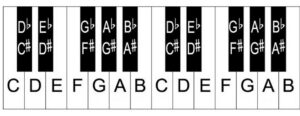
Important: For beginners, this is something to memorize. There are only seven letters involved (A through G). These seven letter names repeat across your entire leyboard, in a fixed, predictable pattern.
Better to memorize this, than to start at square one, with traditional piano lessons, learning simple pieces for kids.
This naming convention is your secret doorway to reading my sheet music with letters.
Letter Notes: Which “E” should I play?
As you can see on the diagram above, any given note name (such as “E”) is repeated up and down your keyboard.
Fear not! When you see an “E” (or any other note name) on my sheet music, you can easily understand exactly which “E” note to play on your keyboard, by looking at the standard music notation that is right next to the letters.
The standard notation tells you which “E” to play.
Familiarize yourself with this diagram below. This is your keyboard landscape.
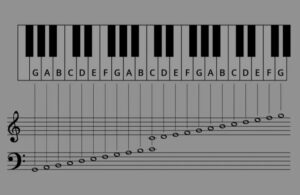
Orientation note: In the image above, the note “C” that appears directly centered between the “treble staff” (upper group of lines), and the “bass staff” (lower group of lines) is called “Middle C.” This is the “C” key closest to the center of your keyboard.
Going forward:
My plan for this website is to publish many more posts and videos, in order to allow your journey into the world of standard piano notation and sheet music with letters to become your easy guide to playing advanced piano pieces. I want you to start playing music that you had only dreamed of learning!
Here’s an example of what I’m now offering on blog:
Video: How to Read Piano Music: Naming the WHITE KEYS
VISIT MY SHEET MUSIC WITH LETTERS SHOP
Kent
Great content! Keep up the good work!
Thank you so much!